

The Ultimate Cold Email Playbook: How to Build and Sclae Your Outreach

How to Book 15 Meetings and Scale to 70+ Demos Per Month: The Cold Email Playbook That Actually Works
You know that feeling when you check your calendar and it's emptier than a ghost town on Sunday? Meanwhile, your competitor just posted another "We're hiring!" announcement on LinkedIn. Their SDR team is half the size of yours, but somehow they're crushing it.
What gives?
Here's the cold, hard truth that'll sting like a paper cut: You're still playing by 2019 rules in a 2025 world. While you're manually crafting "personalized" emails that get a whopping 1-2% response rate (if you're lucky), the top dogs are running systems that book 70+ demos per month on autopilot.
After 5 years in the trenches, building outbound machines for 80+ B2B companies, we've seen it all. The good, the bad, and the "why did you even send this?" ugly. And you know what? The secret sauce isn't about writing cleverer subject lines or sprinkling in more emojis 🚀.
It's about building a machine that delivers a 4.9% conversion rate. Yeah, you read that right – nearly double what most teams consider "good."
Ready to stop being the best-kept secret in your industry? Let's dive in.
Why Your Old Playbook is Deader Than Disco
Remember the good ol' days? Blast 10,000 emails, use a template that starts with "I hope this email finds you well," and watch the meetings roll in. Those days are as gone as flip phones and fax machines.
Today's buyers? They're drowning in a tsunami of terrible outreach. Their inboxes have more guards than Fort Knox – AI-powered spam filters that can smell a mass email from a mile away. One whiff of "Dear {{FirstName}}" and boom – straight to spam jail.
The Game Has Changed (And Most Teams Haven't Noticed)

Here's what separates the wheat from the chaff:
The Old Way:
- Spray and pray like it's a water gun fight
- Hope your generic template hits someone at the right time
- Celebrate your 1% response rate like you won the lottery
- Wonder why your SDRs are burning out faster than birthday candles
The New Way (That Actually Works):
- Build a hybrid prospecting engine that's part automation, part human touch
- Hit prospects with the right message at the perfect moment
- Watch response rates climb to 10-15% (no, that's not a typo)
- Book 1 meeting for every 200-800 contacts instead of every 2,000
The results speak louder than a heavy metal concert:
- 90% inbox placement (while everyone else lands in spam)
- 70%+ open rates (before tracking went the way of the dodo)
- Positive responses that actually turn into meetings
- SDRs who don't need therapy after 6 months
The 3-Pillar System That'll Transform Your Pipeline
Pillar 1: Email Infrastructure That Doesn't Suck
Let's get one thing straight: If your infrastructure is garbage, everything else is just lipstick on a pig. Most teams skip this part like it's vegetables at dinner, then wonder why they're landing in spam faster than you can say "unsubscribe."
The Multi-Domain Strategy (Or: Don't Put All Your Eggs in One Basket)
Sending from your main domain is like wearing a "kick me" sign to a middle school. You need at least 10 secondary domains, each with 3-5 inboxes, all properly warmed up like a cozy fireplace in winter.
Why so many? Because when you're sending 300-500 emails daily (scaling to 1,500 when you're really cooking), distribution is everything. One bad apple doesn't just spoil the bunch – it burns down the whole orchard.
Quick Win: Start with 3 domains, warm them for 2 weeks minimum, then gradually scale. Rome wasn't built in a day, and neither is a killer email infrastructure.
The Weekly Health Check (Your Early Warning System)
Here's what most teams do: Set it and forget it. Here's what happens next: Their domain reputation tanks faster than a lead balloon.
Smart teams monitor three things religiously:
- IP sender scores (your digital street cred)
- Domain health (are you on any naughty lists?)
- Inbox placement rates (the only metric that matters)
Think of it like checking your car's oil – ignore it, and you'll be stranded on the side of the highway wondering what that burning smell is.
[Our complete playbook includes the exact monitoring schedule and tools we use to maintain 90% inbox placement. Don't leave your success to chance.]
Pillar 2: Targeting Like You Actually Give a Damn
This is where 90% of companies face-plant harder than a skateboarder on their first day. They think "B2B SaaS companies with 50-500 employees" is targeted.
Newsflash: That's not targeting. That's throwing darts blindfolded and hoping you hit something.
The ICP Onion Method™ (Yes, We're Going There)

Your ideal customer is like an onion – it has layers, it might make you cry, but when you peel it back properly, it's golden. Surface-level targeting gets you surface-level results. You need to go deeper than a philosophy major at 2 AM.
Layer 1: The Obvious Stuff
- Industry, company size, location
- The basics everyone uses (and wonders why they sound like everyone else)
Layer 2: The Tech Stack
- What tools are they using?
- What did they just implement?
- What are they probably struggling with?
Layer 3: The Behavioral Signals
- Who are they hiring?
- Did they just raise funding?
- Are they expanding to new markets?
Layer 4: The Human Element
- What's their background?
- Who do they report to?
- What keeps them up at night?
Here's the difference in action:
Lazy Targeting: "RevOps leaders at B2B companies"
Smart Targeting:
- RevOps leaders at B2B SaaS companies
- Using Salesforce (installed in last 12 months)
- Former sales reps (they get the struggle)
- Currently hiring SDRs (growth mode activated)
- Report to VP Sales or CRO (know their boss's priorities)
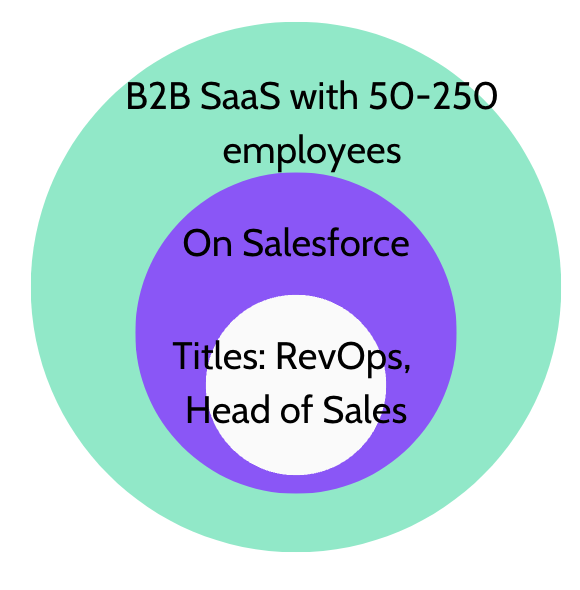
See the difference? It's like comparing a butter knife to a laser – one spreads thin, the other cuts deep.
The Signal-Trigger Framework (Your Crystal Ball)
Most teams are shooting in the dark, hoping their timing isn't terrible. Meanwhile, smart teams use signals and triggers like a GPS for perfect timing.
Signals = They might be ready
- New VP of Sales joined
- Posted about scaling challenges
- Competitor just raised prices
Triggers = They're engaging
- Visited your pricing page
- Downloaded your content
- Liked your CEO's LinkedIn post
We've identified 63 distinct sales signals that indicate "hey, I might actually need what you're selling." Using just 3-4 of these can triple your response rates faster than you can say "pipeline."
[Get all 63 sales signals plus our proprietary trigger identification framework in the full playbook. Stop guessing, start knowing.]
Pillar 3: Messaging That Makes Them Actually Want to Reply
Time for some tough love: Nobody cares about your product features. They don't care about your company history. They definitely don't care that you're "reaching out to introduce yourself."
They care about their problems. Period. End of story.
The 4-Email Symphony (Each Note Matters)
After testing more variations than a DJ at a wedding, we've found the perfect sequence:
- Email 1: The Hook (Problem-focused, not you-focused)
- Email 2: The Context (Add value, don't just "bump")
- Email 3: The Pivot (New angle, same problem)
- Email 4: The Finale (Last chance to dance)
Each email is like a scene in a movie – skip one, and the story doesn't make sense.
Anatomy of an Email That Actually Gets Responses
Let's dissect what works like a high school biology class (but more fun):
Subject Line: 1-3 words, lowercase, no BS
- Bad: "Revolutionary Solution for Your Revenue Operations Challenges!"
- Good: "quick question"
- Better: "{{mutual connection}}"
Line 1: Show you did your homework
- Bad: "I hope this email finds you well."
- Good: "Saw you're hiring 5 SDRs this month."
- Better: "Noticed you mentioned pipeline challenges in your SaaStr talk."
Line 2: Poke the bruise (gently)
- Bad: "We offer solutions for companies like yours."
- Good: "Scaling SDR teams usually means doubling your tech stack costs."
- Better: "If you're like most RevOps leaders, you're probably spending 40% of your time on manual data tasks."
Line 3: How you help (with proof)
- Bad: "We're the leading solution in the market."
- Good: "We help RevOps teams automate repetitive tasks."
- Better: "We helped Acme Corp cut manual work by 67% – their RevOps team actually goes home at 5 PM now."
Line 4: The CTA (make it irresistible)
- Bad: "Do you have 30 minutes for a call?"
- Good: "Worth a quick chat?"
- Better: "Can I show you exactly how Acme automated their lead routing in 10 minutes?"
Line 5: The P.S. (your secret weapon)
- Add a specific metric, insight, or observation
- This is where personality lives
- Make it memorable
[Our complete template library includes 48 variations of each element, plus real examples that generated responses. It's like having cheat codes for cold email.]
Testing, Iterating, and Scaling: The Scientific Method Meets Sales
Here's where most teams go wrong: They launch one campaign, get mediocre results, and either give up or – worse – keep sending the same garbage hoping for different results. That's like expecting your houseplant to grow by yelling at it.
The Performance Benchmarks (Your North Star)
Track these numbers like your business depends on it (because it does):
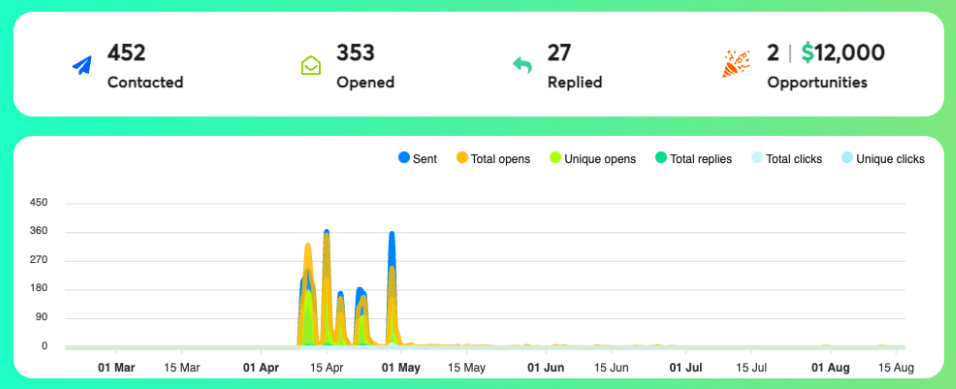
- 1 response per 200 contacts = You've struck gold, scale to the moon 🚀
- 1 response per 800 contacts = Room for improvement, time to iterate
- 1 response per 1000+ contacts = Houston, we have a problem
We typically land in the 200-800 range, which puts us in the "actually knowing what we're doing" category.
The Re-Prospecting Revolution (Second Chances Are Real)
Your TAM isn't moving to Mars. Those prospects who said "not interested" in Q1? They might be desperately Googling solutions in Q3.
Every 90 days, you can re-engage with fresh angles. It's like seasons – what didn't bloom in spring might flourish in fall. People's priorities shift faster than fashion trends:
- New boss, new priorities
- Budget season approaching
- Competitor just screwed them over
- That "future project" became "urgent yesterday"
Evergreen vs. One-Off: Playing Chess While Others Play Checkers
One-Off Campaigns = Fishing with a rod
- Manual everything
- Start from scratch each time
- Inconsistent results
- SDR burnout central
Evergreen Campaigns = Fishing with nets while you sleep
- Automated monitoring of your TAM
- Triggers fire personalized sequences
- Consistent pipeline flow
- SDRs focus on selling, not searching
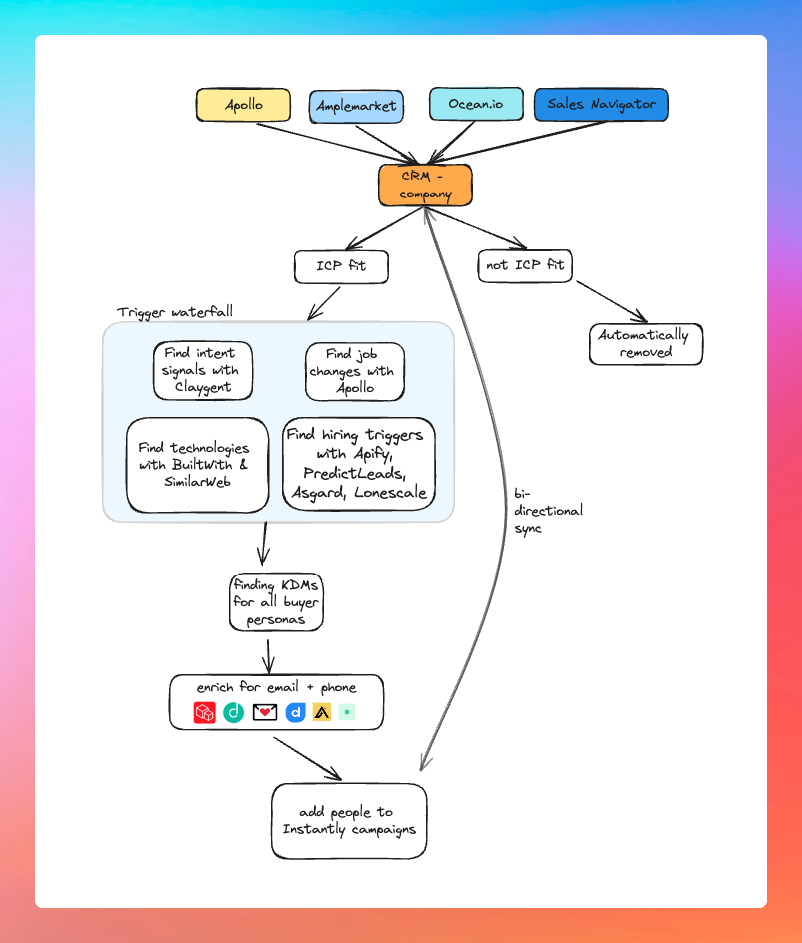
Picture this: While you're sipping your morning coffee, your system is:
- Finding companies that just installed your competitor
- Enriching them with decision-maker data
- Personalizing outreach based on 15 data points
- Queuing them up for your SDRs to call
That's not the future – that's what winners are doing right now.
This is what it looks like:
[Learn how to build evergreen campaigns that run 24/7/365 in our complete playbook. Your future self will thank you.]
5 Advanced Strategies the 1% Don't Want You to Know
1. Network-Powered Case Studies (It's Not What You Know...)
Stop sending generic case studies. Start making them personally relevant. Here's the secret sauce:
- Map your LinkedIn network to case study champions
- Find mutual connections
- Reference these connections in outreach
- Watch response rates double faster than a caffeinated squirrel
Example Magic: "Saw you're connected with Sarah from TechCorp. She told me their pipeline increased 47% after implementing our approach. Figured you'd want to know what worked..."
2. Verticalized Campaign Streams (One Size Fits None)
Generic messages are like vanilla ice cream – fine, but nobody's excited about it. Create industry-specific sequences that speak their language:
- For SaaS: Reference their MRR, churn, CAC
- For E-commerce: Talk conversion rates, cart abandonment, AOV
- For Healthcare: Mention compliance, patient satisfaction, efficiency
Each vertical gets its own playbook, case studies, and pain points. It's like having a different key for every lock instead of trying to jimmy everything with a paperclip.
3. Influencer Engagement Campaigns (Ride the Wave)
Find prospects engaging with thought leaders, then surf that wave:
- Monitor who's commenting on industry influencer posts
- Reference specific ideas from those posts
- Connect the dots to your solution
- Instant credibility and relevance
In Action: "Loved your comment on Chris Walker's post about dark social. We've actually built a way to track those invisible touches – want to see how?"
4. Content Deposits (Give Before You Get)
Stop asking for meetings immediately. It's like proposing on a first date – desperate and ineffective. Instead:
- For Sales Teams: "Built a commission calculator based on your job posting. Want it?"
- For Marketers: "Created a competitor ad analysis for your industry. Interested?"
- For RevOps: "Made a lead scoring template for Salesforce. Should I send it over?"
Give value first. Meetings come naturally when you're actually helpful.
5. Visual Prospecting (Show, Don't Tell)
Words are great. Visuals are unforgettable. We're talking:
- Mock up their website with your solution
- Create personalized video walkthroughs
- Build custom dashboards with their data
- Design before/after comparisons
It's the difference between describing a sunset and showing a photo. One makes them think, the other makes them feel.
Real Results From Real Companies (Names Changed to Protect the Successful)
Let's talk numbers that'll make your CFO do a double-take:
B2B SaaS Company A: From Crickets to Chorus
- Before: 8 meetings/month (mostly accidental)
- After: 73 meetings/month in 90 days
- Secret Weapon: Signal-based targeting + vertical campaigns
- ROI: 812% in 6 months
Services Company B: The Conversion Kings
- Before: 1.2% email-to-meeting rate
- After: 4.9% conversion rate (yes, really)
- Secret Weapon: Visual prospecting + content deposits
- Result: Had to hire more AEs (good problem)
Tech Startup C: David Beats Goliath
- Before: 0 demos (just launched)
- After: 50 demos/month with just 3 SDRs
- Secret Weapon: Evergreen campaigns + network plays
- Outcome: Series A in 18 months
Enterprise Company D: Efficiency Excellence
- Before: $487 cost per meeting
- After: $163 cost per meeting
- Secret Weapon: Complete system overhaul
- Bonus: Doubled volume while cutting costs
[Get the complete case studies with tactical breakdowns in our full playbook. See exactly how they did it.]
The Uncomfortable Truth Nobody Talks About
Let's have a heart-to-heart. Building this system isn't like assembling IKEA furniture (though both might make you swear). It's complex. It requires:
The Reality Check:
- Technical Expertise: Domain setup, deliverability monitoring, integration nightmares
- Data Mastery: Enrichment waterfalls, signal tracking, lead scoring
- Copy Skills: Writing that converts, not just communicates
- Analytical Discipline: Testing, iterating, optimizing (repeat forever)
- Time Investment: 10-12 hour days initially if DIY-ing
Most teams try to build this themselves. Here's what happens:
- Month 1: Enthusiasm! "We got this!"
- Month 2: Reality hits. "This is harder than expected..."
- Month 3: Back to spray and pray. "Maybe next quarter..."
The Three Paths Forward:
Path 1: The Status Quo
- Keep doing what you're doing
- Keep getting what you're getting
- Watch competitors pull ahead
- Wonder what went wrong
Path 2: The DIY Adventure
- Budget 3-6 months minimum
- Dedicate a full-time resource
- Prepare for mistakes (expensive ones)
- Maybe succeed, maybe not
Path 3: The Fast Track
- Get the complete playbook
- Compress months into days
- Learn from 80+ implementations
- Skip the expensive mistakes
Your Next Move (Choose Wisely)
Look, this blog post is like a movie trailer – exciting, informative, but only scratching the surface. We've shown you maybe 20% of what you need to know. The devil's in the details, and the details are in the playbook.
What You're Missing:
Infrastructure Deep Dive:
- Step-by-step domain setup guides (with screenshots)
- Exact warmup schedules that work
- Weekly monitoring checklists
- Troubleshooting guides for every scenario
The Complete Email Template Library:
- 50+ proven templates organized by industry
- Subject line swipe file (127 that actually work)
- P.S. line formulas that generate curiosity
- A/B test results from 100,000+ sends
Advanced Targeting Strategies:
- All 63 sales signals with implementation guides
- Signal combination strategies for 10x results
- Tool configurations for automated monitoring
- TAM building frameworks by vertical
Technical Implementation:
- CRM integration blueprints
- Automation workflow diagrams
- Data enrichment waterfalls
- Quality assurance processes
Scaling Strategies:
- Hiring and training SDR playbooks
- Performance tracking dashboards
- Commission structure recommendations
- Tech stack optimization guides
The Bottom Line (Time to Choose Your Fighter)
Cold email isn't dead. Lazy cold email is dead. Boring cold email is dead. Generic cold email is deader than dead.
The teams crushing it today have systems, not hopes. They have processes, not prayers. They have predictable pipeline, not random acts of sales.
The math is simple:
- Your current approach: 1-2% response rate, struggling to book meetings
- The playbook approach: 4.9% response rate, 70+ demos per month
- The difference: Everything
The question isn't whether this works – we've proven it across 80+ companies in every industry imaginable. The question is whether you're ready to stop playing small ball and start hitting home runs.
Your calendar doesn't have to look like a desert. Your SDRs don't have to burn out. Your pipeline doesn't have to be a mystery.
The playbook is waiting. The only thing missing is you.
[Download the complete playbook now and join the 1% who've figured out how to make outbound a predictable, scalable revenue engine. Includes templates, tools, and tactics you can implement today.]
Growth Today isn't your typical agency. We don't do decks. We don't do endless strategy sessions. We build systems that work, implement processes that scale, and deliver results that matter. Ready to stop talking and start doing? Let's build something incredible together.
Ready to accelerate your pipeline?
Reach out to discuss how we can help your GTM team scale with automation and expertise.