
Bigblue

How Bigblue qualified merchants on data no provider sells, then ran the same motion in three countries
Growth Today built custom models to estimate the operational data that decides whether an ecommerce merchant is worth contacting, then localized the same motion into Spain and France.
Impact TL;DR
- A custom order-volume model that landed within 20% of actual volumes, where the incumbent tool was off by more than 3x
- Product weight estimated directly from the merchant's catalog, disqualifying merchants who look good on paper but whose products are too heavy to serve
- Industry re-categorized by reading the actual product catalog rather than trusting a high-level classification
- Carrier and tracking experience scraped per merchant, then used directly in the first line of the email
- Five or more personas prospected per account, each with messaging mapped to their own goals
- The same motion localized into Spain and France, with copy adapted rather than translated
Qualifying merchants on a number that was wrong by 3x
Bigblue's qualification depended on monthly order volume. A merchant shipping a few hundred orders a month is a different business from one shipping thousands, and the fulfilment conversation only makes sense above a threshold. They were reading that number from a third-party ecommerce data tool.
When we validated those estimates against merchants where the real volume was known, the tool came in more than 3x high. Measured as variance from actuals, it sat at 331% while the model Growth Today built sat at 21%. Sequences built on the inflated numbers were reaching merchants who could never qualify, and the reps had no way to see it from the data in front of them.
The other two decisive data points did not exist anywhere as fields. Product weight determines whether Bigblue's network can serve a merchant economically, and it lives in the product catalog rather than in a purchasable B2B database. A merchant's current carrier, and whether shoppers can track their order on the carrier's generic tracking page, is the specific pain Bigblue solves, and it is visible only by visiting and reviewing the tracking pages, terms and brand details of each store.
Key challenges were:
- Order volume estimates inflated by more than 3x, routing unqualified merchants into sequences
- Product weight cannot be purchased through major B2B databases, despite deciding whether an account can be served
- Carrier and tracking experience unavailable, even though this is the core value proposition
- Site self-classification unreliable, so category filters caught the wrong merchants
- European go-to-market requires localized copy in Spanish and French markets rather than English
Growth Today rebuilt qualification on data that had to be generated rather than bought
Instead of buying generic merchant data and filtering on it, we built a system where:
- Order volume is modelled from observable signals and validated against known actuals
- Product weight is estimated from the merchant's own catalog
- Industry is assigned by reading what the merchant actually sells
- The carrier and tracking experience is detected per store
- Every qualification data point is also available to the copy
- The same logic runs in a new country without rebuilding
None of this was going to work at a cost per account that made sense across a large merchant universe. So the whole qualification layer was built to run at under a tenth of a cent per merchant, including the AI steps.
Building an order-volume model to replace the tool
What we did: Rather than accept the tool's estimate, we built a custom model to estimate each merchant's monthly order volume from observable signals, and validated it against merchants whose real volumes Bigblue could confirm.
The outcome: The model landed within roughly 20% of actual volumes. The incumbent tool, measured the same way, came in at 331%. Qualification then ran on the model output, which moved the threshold decision onto a number the team could back up. Qualifying a store cost under $0.001.
If you are qualifying accounts on a third-party estimate, validate it against a sample where you know the truth before you build a motion on top of it. The variance is often large enough to change who ends up in the sequence.
Generating operational data points that no provider sells
Three data points were built per merchant, each from the store itself:
- Product weight. AI read the product catalog and estimated the weight of what the merchant sells. Merchants whose products are too heavy for Bigblue's network were disqualified before entering a sequence
- Industry re-categorization. AI browsed the catalog and assigned the merchant's real category, replacing the classification the site claimed for itself
- Carrier and post-purchase experience. Each store was checked for the carrier in use and whether shoppers were being sent to that carrier's standard tracking page
All three doubled as copy inputs. The carrier detection in particular went straight into the opening line, which referenced the merchant's actual carrier and the tracking experience their shoppers were getting.
Personalizing on operational reality rather than firmographics
What we did: We prospected five or more personas per account and wrote messaging for each, referencing that persona's goals and challenges rather than the company's. The first line of each email used the merchant's own operational situation: the carrier they run, the tracking page their shoppers hit, and the volume band they sit in. A general manager received a different framing from an ecommerce lead at the same store.
The outcome: 60%+ open rates, a 6% reply rate, and 13% of replies positive, with a further 11% neutral and worth a call. Five sales-qualified leads came out of the first week. Most sequences drove $18,000 by contacting an average of 210 contacts, with an 81% open rate and a 6.7% reply.
Four triggers, four sequences
Each sequence starts from a different operational fact about the merchant. The highlighted text below is generated per store, not written by hand.
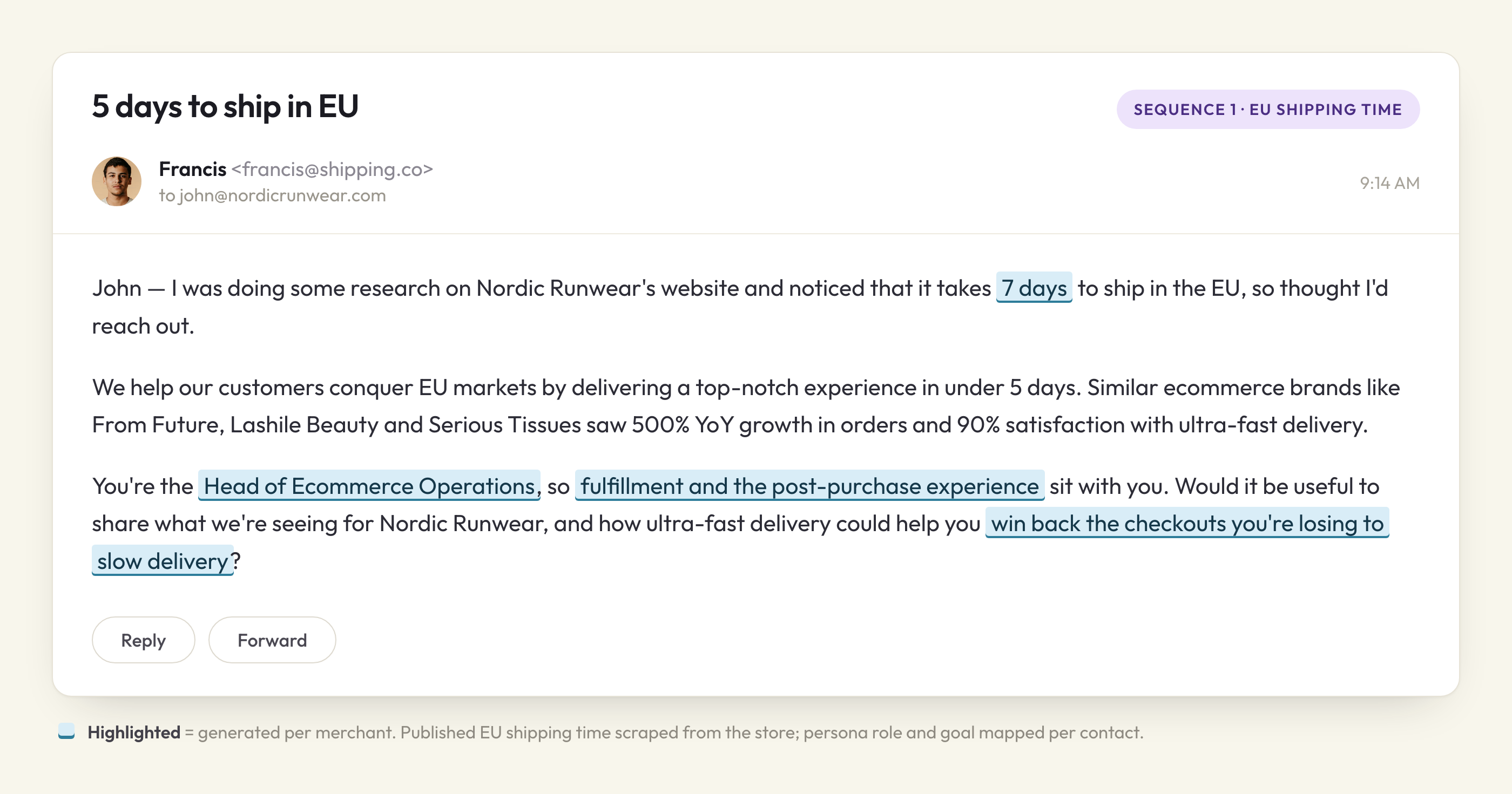
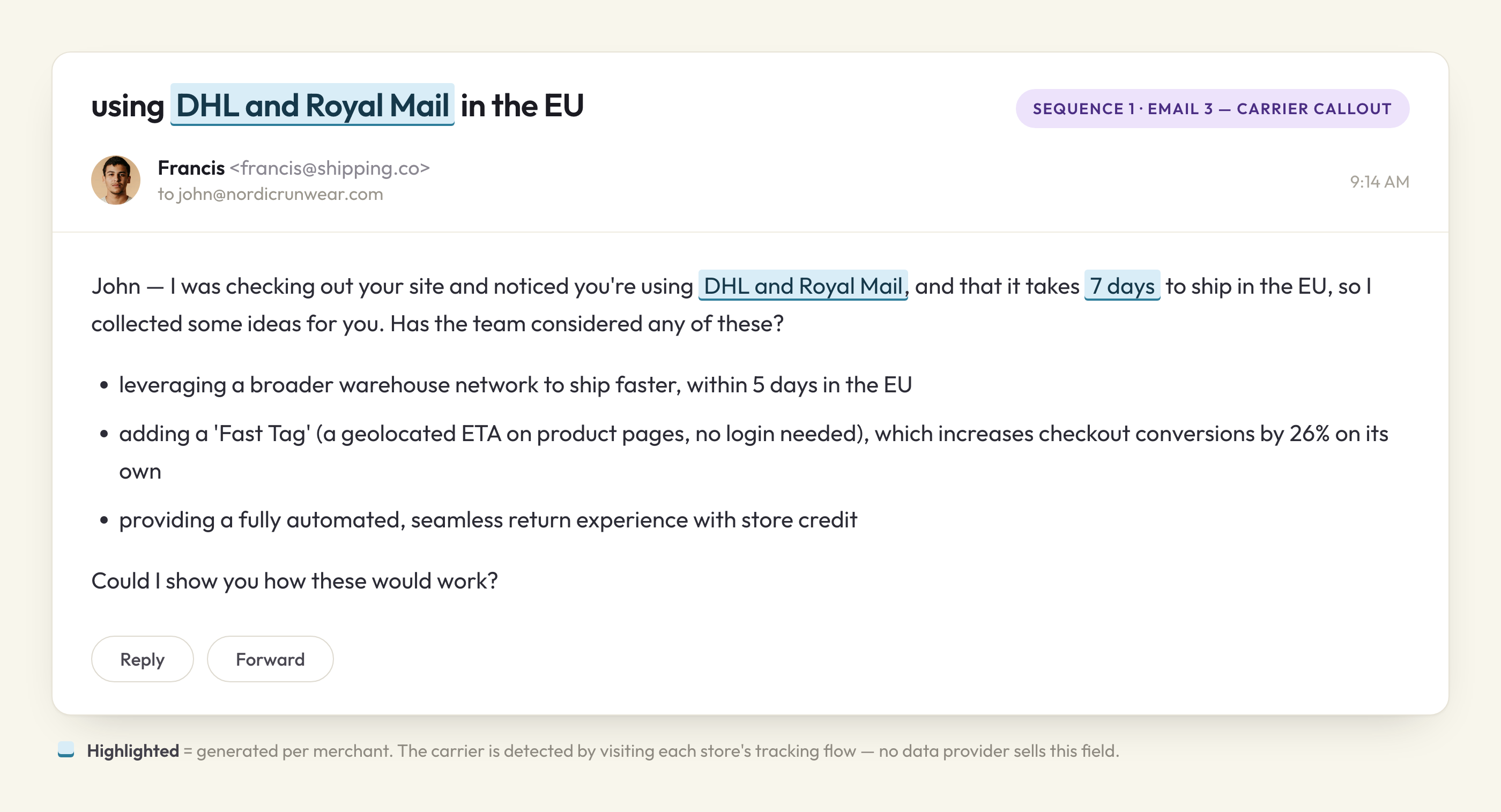
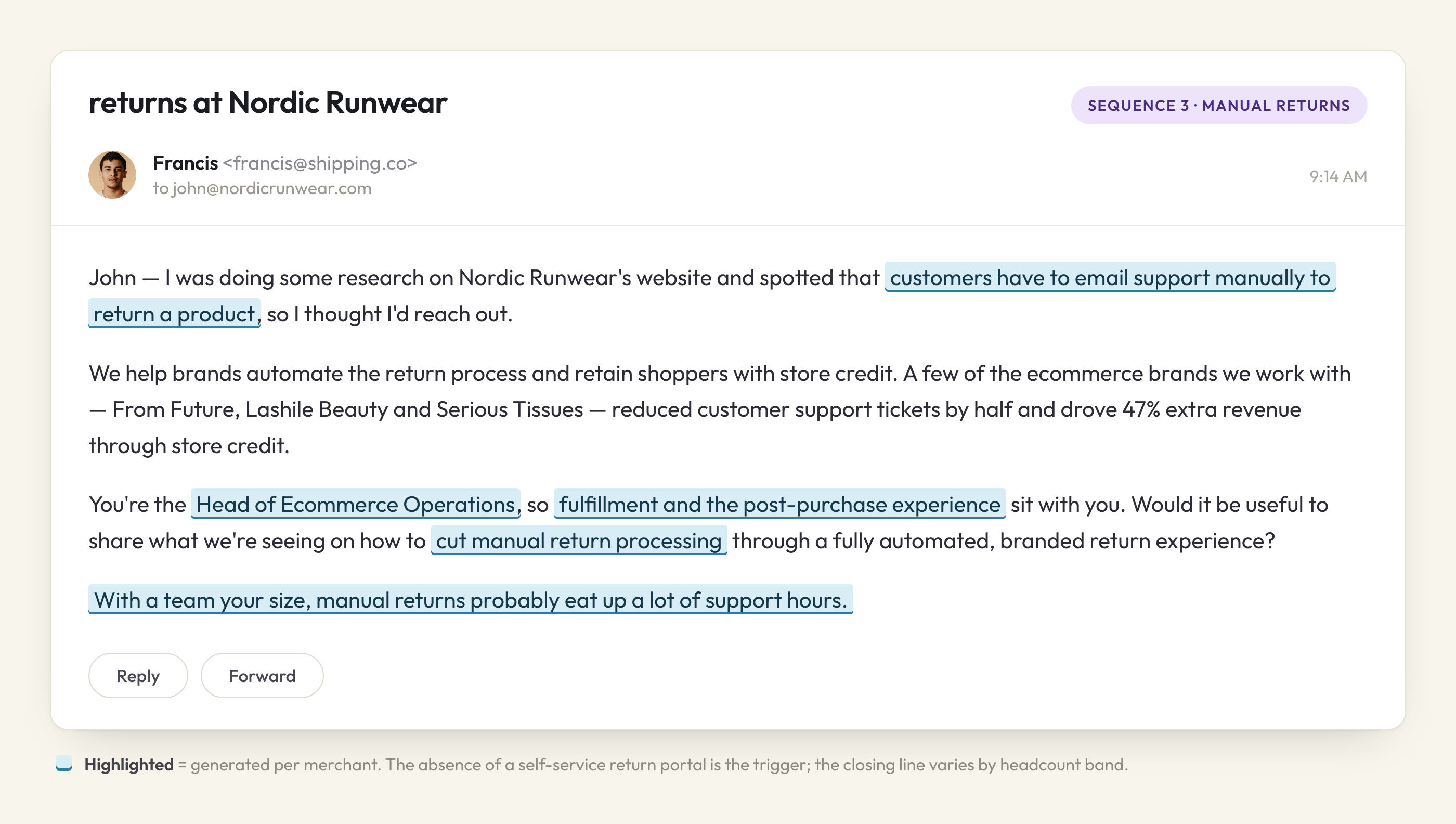
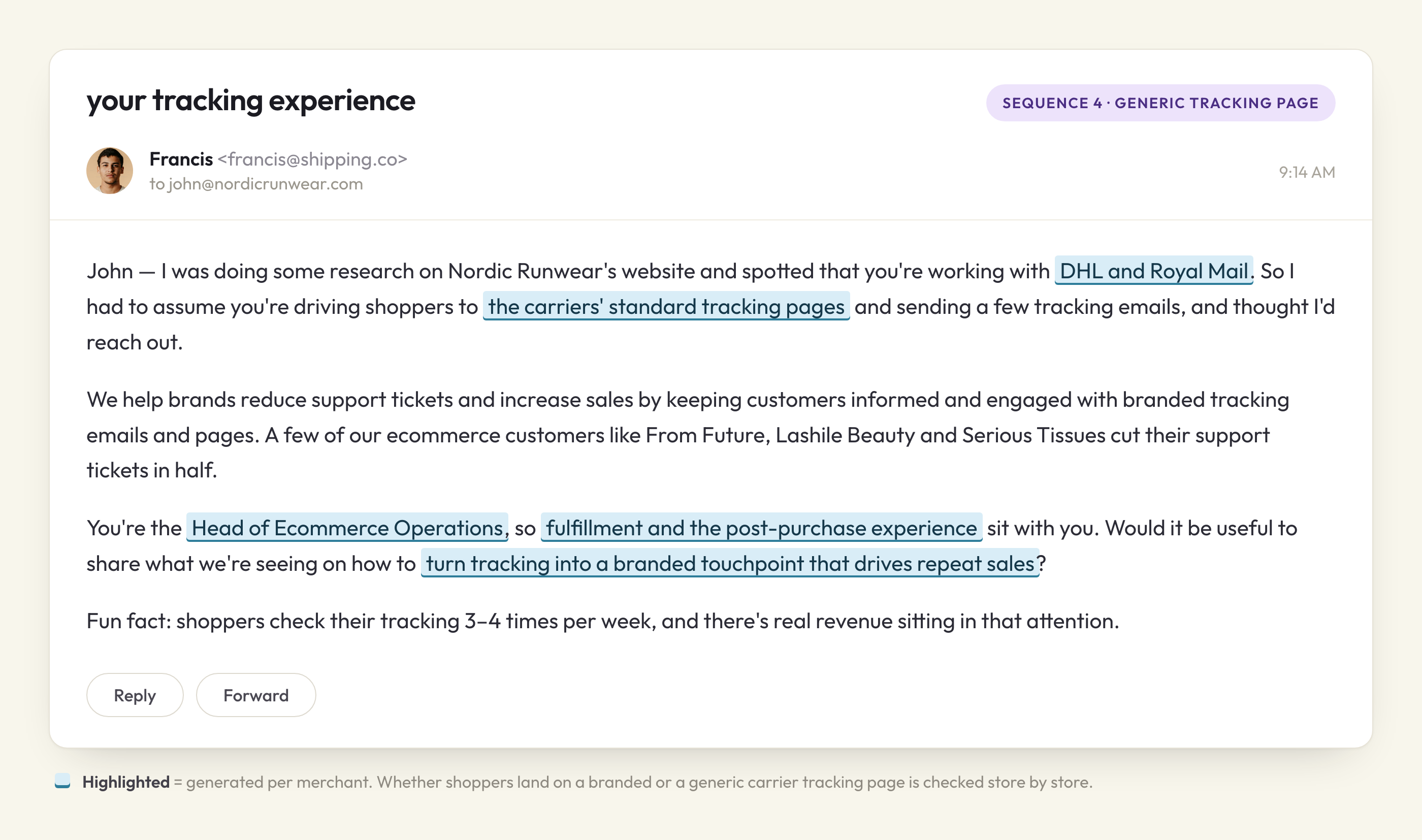
A fifth variable ran underneath all of them: each step was written in five or six variants, testing whether proof-first beat question-first, and whether a scannable checklist beat prose once the thread was already open.
Localizing the motion into Spain and France
What we did: With the qualification layer proven in the UK, we localized it rather than rebuilt it. Copy was adapted into Spanish and French, and the qualification model, weight estimation and carrier detection ran unchanged against merchants in those markets.
The outcome: Bigblue prospected Spain and France on the same system. Because the qualification data points are generated from the merchant's own store rather than pulled from a regional database, the model does not degrade when the country changes, which is the usual failure mode when a provider's coverage thins outside its home market.
Why Bigblue Chose Growth Today
A qualification layer built from scratch and executed with creative, highly relevant prospecting
Bigblue's qualification depends on three operational facts about a merchant, and none of them are sold as data. The work was not to source a better provider. It was to model and generate the data, validate it against known truth, and make it cheap enough to run across a whole market.
- Validated against actuals. The order-volume model was measured against merchants with known volumes before it qualified anyone
- Qualification and personalization from one layer. Every data point built for filtering was also available to the copy
- Portable across markets. The same logic ran in Spain and France without a new data source
Results & Impact
RevOps Impact
- Order-volume estimates within 20% of actuals, replacing a tool that ran 331% off
- Three operational data points generated per merchant where no provider offered them
- Qualification at under $0.001 per store, cheap enough to run across the full merchant universe
- Category assignment from the product catalog, replacing unreliable site self-classification
Sales Impact
- 60%+ open rate and 6% reply rate, with 13% of replies positive and 11% neutral
- Five sales-qualified leads in the first week
- Five or more personas mapped per account, each with its own messaging
- Unqualified merchants filtered before contact, so reps stopped working stores they could not serve
Leadership Impact
- Spain and France launched on the proven system, with copy adapted rather than rebuilt
- The qualification threshold rests on a validated model, so volume decisions are defensible
By generating the qualification data instead of buying it, Bigblue built a merchant filter that travels to a new country without a new data source.


Ready to accelerate your pipeline?
Reach out to discuss how we can help your GTM team scale with automation and expertise.