
Mode Mobile

How Mode Mobile turned half its replies into opportunities by getting the vertical right
Growth Today ran five vertical campaigns for Mode Mobile in parallel, measured reply-to-opportunity conversion rather than reply rate, and concentrated volume on the verticals that converted.
Impact TL;DR
- 54% of replies converted to opportunities on the game developer vertical
- 27% conversion on the crypto vertical, roughly one opportunity per four replies
- 21 opportunities across the programme, 11 of them inside a two-week window
- Five verticals tested in parallel, with two identified as unproductive and paused
- Booked calls with established game studios, including publishers with international footprints
- Volume reallocated toward converting verticals rather than spread evenly
Several business lines, several possible buyers, no evidence
Mode Mobile's monetization spans performance advertisers, newsletter sponsors and app publishers. Their newsletter network alone sends at very large monthly volume across separate titles with different audiences. Each business line has a different buyer, a different value proposition and a different competitive set.
They had been running sponsored newsletter outreach through a single provider's data, which worked for about six weeks before the list showed signs of drying up. That is the standard failure of a single-source list against a single vertical: it works until the addressable slice is exhausted, and it teaches you nothing about the other verticals.
The harder question was which vertical to invest in. Reply rate alone would not answer it, since a vertical can reply readily and convert nothing, and another can reply rarely and convert most of what it produces.
Key challenges were:
- Multiple business lines with distinct buyers and value propositions
- A single-source list showing exhaustion after roughly six weeks
- No evidence on which vertical converts, only on which replies
- Follow-up handling undefined across a distributed internal team
- Reply rates structurally low against large lists in these verticals
Growth Today ran the verticals concurrently and measured them on the metric that decides where to spend
Instead of picking one vertical and optimizing it, we built a system where:
- Several verticals run in parallel with their own list, copy and value proposition
- Each is reported on reply rate and reply-to-opportunity conversion separately
- The value proposition is tailored per vertical rather than reused with the industry name swapped
- Prioritization follows the opportunities that actually close, not the reply rate
- Responses are routed to the right owner, since each vertical has a different one
Measuring conversion, not reply rate
What we did: Every campaign reported sends, replies, reply rate, opportunities, opportunity rate and reply-to-opportunity conversion. Reporting the last two separately matters, because reply volume on its own dilutes the learning.
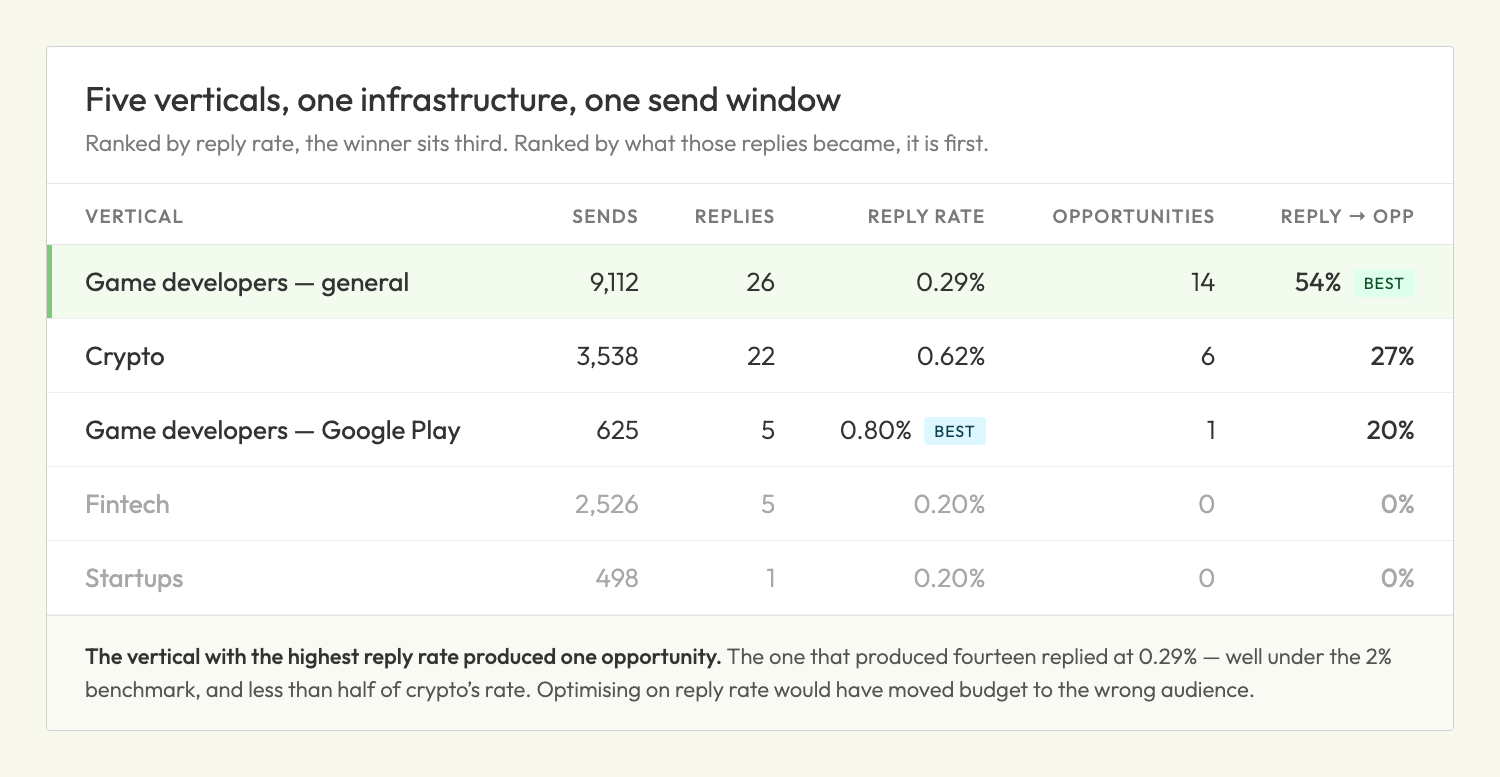
The outcome: Game developer sequences drove only a 0.29% reply rate, well under the usual 2% benchmark for large lists, but 54% of those replies converted into opportunities: 26 replies, 14 opportunities. Crypto produced a 0.62% reply rate and converted 27%, roughly one in four. Fintech produced 5 replies across 2,526 sends and converted none of them.
A vertical that replies less and converts more is worth more volume than one that replies more and converts nothing. If you optimize on reply rate alone, you will move budget toward the wrong audience.
Running five verticals in parallel
The programme ran concurrently rather than sequentially:
- Game developers, general list. 9,112 sends, 26 replies, 14 opportunities. The strongest sales play, and the largest allocation of email bandwidth
- Crypto. 3,538 sends, 22 replies, 6 opportunities. Second strongest, and prioritized for more volume to keep testing the sales play
- Fintech. 2,526 sends, 5 replies, 0 opportunities. Reported as unproductive rather than optimized further
- Game developers, Google Play Store list. 625 sends, 5 replies, 1 opportunity, and the highest reply rate in the programme at 0.80%
- Startups. 498 sends, 1 reply, 0 opportunities. Paused, with a recommendation to target more mature startups if revisited
Running them together meant the comparison was clean. The same infrastructure, the same period and the same team, so the difference in conversion is attributable to the vertical and the message rather than to timing.
Writing a different value proposition per vertical
What we did: Each vertical got its own argument rather than a shared one with the industry name changed. Game developers were approached on retention and incremental revenue from integrating into the earn ecosystem and cross-promoting titles. Crypto projects were approached on tokenized rewards and network integration. Fintech was positioned as reaching a large base of budget-conscious users as an acquisition channel. Personalization referenced the prospect's own product: their game, its rating, its recent updates, or their funding.
The outcome: The verticals where the value proposition mapped to something Mode Mobile could demonstrably deliver are the verticals that converted. Where the fit was more theoretical, replies came and opportunities did not.
Booking calls with established studios
What we did: The game developer vertical was aimed at mid-sized Android studios with budget-conscious player bases, which is where the earn model resonated.
The outcome: Booked calls came from established studios with international operations and long-running titles, inside a two-week window. Across the programme, 11 interested replies landed in that same fortnight against 21 since launch, which indicates the motion was accelerating rather than decaying as the lists matured.
Why Mode Mobile Chose Growth Today
A partner who would test several markets at once and report honestly on the ones that failed
Mode Mobile did not know which of their business lines would respond to outbound. The value was in finding out quickly, and in being told plainly which verticals were not working.
- Parallel testing. Five verticals under one infrastructure, so the results are comparable
- Conversion-first reporting. Reply-to-opportunity rather than reply rate alone
- Honest negative findings, so the team could read the market quickly and refine the offer
Results & Impact
RevOps Impact
- 16,000+ emails across five verticals
- Per-campaign reporting on reply rate, opportunity rate and reply-to-opportunity conversion
- Email bandwidth continuously reallocated to the best-performing verticals
Sales Impact
- 54% reply-to-opportunity conversion on the strongest vertical
- 21 opportunities across the programme, 11 of them in a single two-week window
- Booked calls with established international game studios
- Per-vertical value propositions mapped to different product lines
Leadership Impact
- Evidence on which business line to prioritize, instead of commercial intuition
- Transparent offer testing with clear next steps and recommendations
By measuring conversion rather than replies, Mode Mobile found which of its business lines were worth going to market with.


Ready to accelerate your pipeline?
Reach out to discuss how we can help your GTM team scale with automation and expertise.