

GTM Engineer Job Description: Responsibilities, Skills, and Template for 2026


A GTM Engineer turns revenue-system needs into working data, automation, AI, and routing workflows, but the title covers different jobs at different companies. Before you write the job description, decide which practical archetype this person will fill (RevOps Architect, Outbound Systems Builder, Automation Engineer, Growth Experimentation Operator, or AI GTM Builder), how the role's ownership differs from your SDRs and AEs, and where it sits relative to RevOps. Once those choices are made, responsibilities, skills, and interview criteria follow naturally. This guide covers the archetype breakdown, the SDR/GTM Engineer/AE split, a copyable job description template, a real evaluation process, a 90-day framework, and when to hire versus use managed execution.
Most GTM Engineer job descriptions become long lists of tools and disconnected responsibilities. A typical version of this problem looks like one posting asking for CRM administration, outbound copywriting, SQL, Python, AI agent building, attribution modeling, and internal tool development, all in one role.
A better job description works differently. It first defines which GTM system the person will own, what they need to build, and how success will be evaluated. The required tools and skills should follow from that, not the other way around.
This guide helps you make that decision, then gives you a practical structure for writing the description, evaluating candidates, and setting realistic first 90-day expectations.
What is a GTM Engineer?
A GTM Engineer is a technical-commercial builder who turns go-to-market needs into working data, automation, AI, and revenue workflows. The title is not standardized, and the scope varies significantly from one company to another.
Common areas of ownership include CRM data quality, lead and account routing, workflow automation, AI-assisted research, internal tooling, documentation, and adoption. Not every GTM Engineer owns all of these. Live job postings from companies like Attentive, Cresta, and Yuno show three genuinely different versions of the role: one built around RevOps and data enrichment, one built around a broad AI-native commercial and technical scope, and one focused on pre-sales workflows including discovery, demos, and proof of concept work.
This variation is not a problem to solve. It is the reason a generic job description fails. The employer has to decide which version they need before listing qualifications.
GTM Engineer vs. SDR vs. AE: who owns what
A GTM workflow can run perfectly and still create no revenue. That gap can point to unclear ownership: a team hires an SDR and expects them to also fix Clay tables, clean the CRM, and maintain automations, then hires a GTM Engineer and asks why meetings still are not getting booked.
In the outbound motion this guide assumes, the three roles own different parts of the same funnel.
| Role | Primary responsibility | Typical output | Success measures |
|---|---|---|---|
| SDR | Turns go-to-market context into relevant outreach and starts qualified conversations | Sequences, calls, and messaging tests on prioritized accounts | Qualified conversations and meetings created; quality and frequency of feedback shared back |
| GTM Engineer | Designs and operates the systems that decide who gets contacted, how, and with what context | ICP scoring, enrichment waterfalls, routing logic, and the automations that trigger outreach | Workflow adoption and data quality; routing accuracy, speed-to-lead, and pipeline influenced by the motions it runs |
| AE | Owns discovery, the business case, and the commercial close | Discovery calls, proposals, stakeholder and procurement management | Closed-won ratio and revenue |
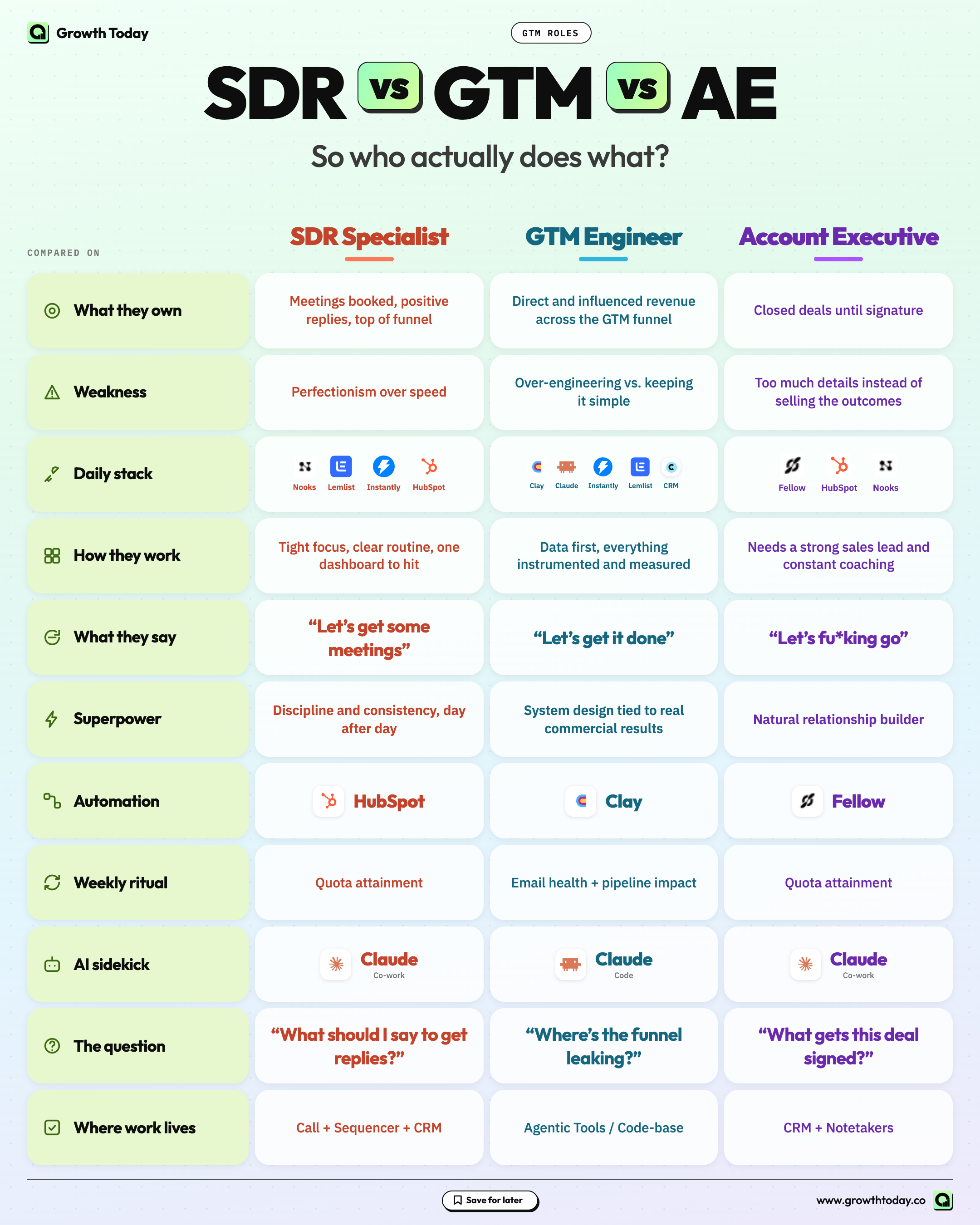
A GTM Engineer is not just technical support for the sales team. In an automated outbound motion, the GTM Engineer's routing and scoring logic decides which accounts get a human SDR, which go into a nurture track, and which get a fully automated sequence. In Growth Today's operating model, a role scoped this way can carry its own pipeline goal for the motions it owns, sometimes with a quota tied to that automated volume specifically. That differs from an SDR's meeting quota or an AE's revenue number, and not every GTM Engineer carries one: it depends on whether the role owns an outbound motion directly or is scoped more narrowly around data and internal tooling.
For example, a high-intent account with a strong signal might route to a named SDR for hands-on outreach, a mid-tier account goes into a nurture sequence, and a well-defined, lower-tier ICP-fit account goes straight into a fully automated sequence the GTM Engineer owns end to end. This describes how one kind of operating model tends to work, not a fixed industry convention; the thresholds are set by each team.
The handoff runs both ways. SDRs and AEs feed back which messaging lands, which signals turn into real conversations, and which accounts were mis-scored, and the GTM Engineer uses that to adjust scoring, routing, and messaging logic. A GTM Engineer who never hears from the sellers using their system is optimizing blind.
Five practical archetypes of the GTM Engineer role
Rather than writing a job description around a stack of tools, start by identifying which system problem this hire will actually solve. The five archetypes below are Growth Today's practical hiring framework, built from the roles we screen and hire against ourselves. They are not a universal or academically validated taxonomy, and a given candidate or job posting will not always map cleanly onto just one.
| Archetype | Primary problem | Representative output | Evaluate, and probe |
|---|---|---|---|
| RevOps Architect | CRM and data infrastructure are inconsistent or hard to trust | CRM architecture, lead routing, lifecycle automation, reporting | Data governance and systems thinking; probe outbound experimentation |
| Outbound Systems Builder | Prospecting and outbound infrastructure cannot scale | TAM pipelines, list-building automation, outbound experiments | ICP judgment and revenue focus; probe CRM architecture depth |
| Automation Engineer | Tools and workflows do not talk to each other | Integrations, signal pipelines, automation workflows | Technical automation skill; probe GTM strategy judgment |
| Growth Experimentation Operator | Funnel performance is not being tested or improved | Experimentation frameworks, messaging tests, segmentation analysis | Analytical rigor and conversion thinking; probe technical build skill |
| AI GTM Builder | GTM workflows are not using AI, or use it carelessly | AI personalization systems, research agents, AI-assisted outreach workflows | Build speed and creativity; probe whether fundamentals get skipped |
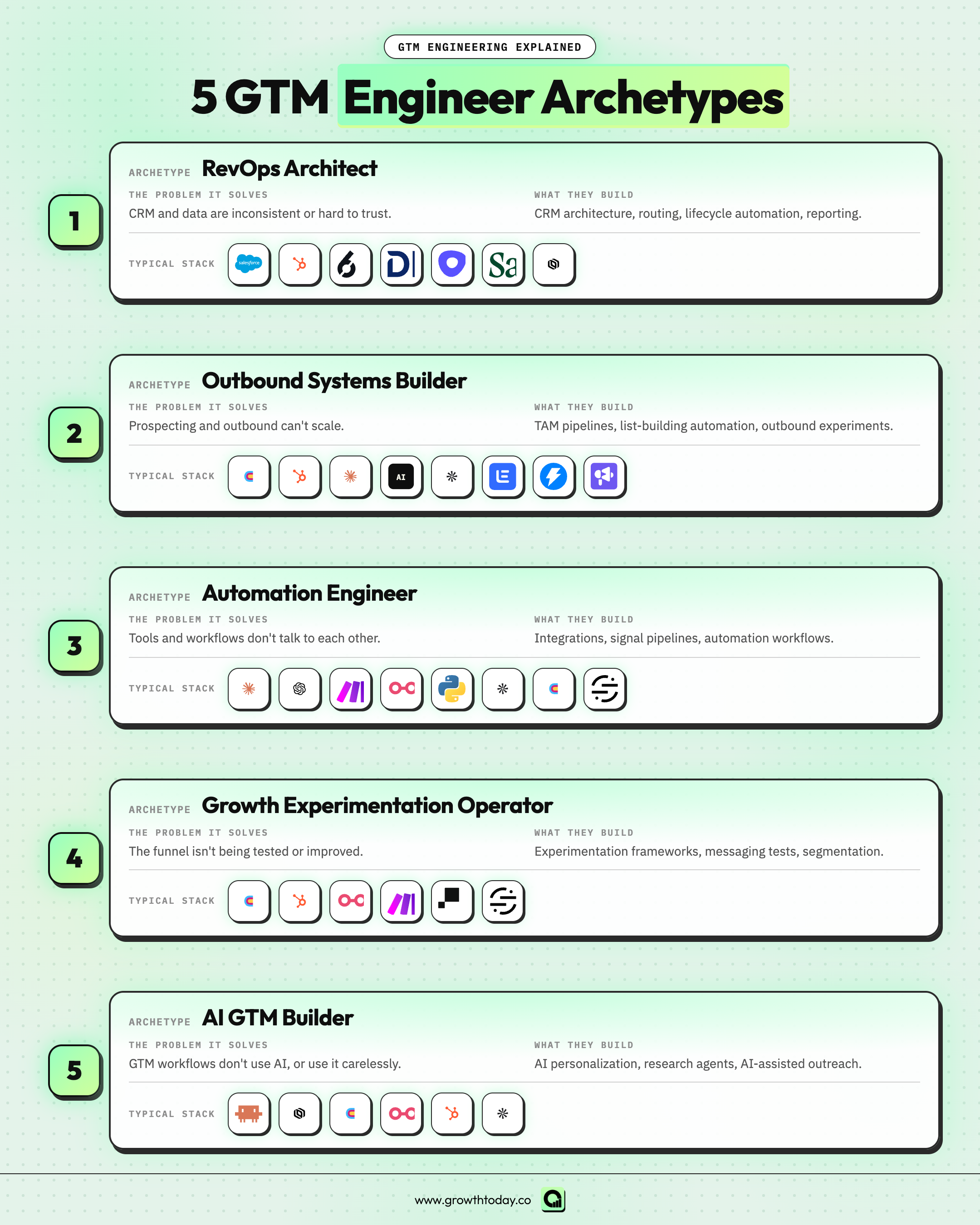
A candidate's weaker area is not a disqualifier by itself; it is what to probe in the interview and calibrate against the actual mandate. Candidates who combine strengths across archetypes are common and often valuable: an Outbound Systems Builder with real Automation Engineer depth is a combination Growth Today looks for often, though that pairing will not be the ideal fit for every employer's mandate.
Some companies also use the GTM Engineer title for pre-sales and deal-support work, AI-assisted research, proposal workflows, demo preparation tied closely to sales engineering. That is a real variation in scope and title use, worth naming explicitly if that is the job you are hiring for.
A company can combine a primary archetype with one supporting area, but trying to cover all five in one seat usually means the role owns everything and therefore owns nothing clearly.
For example, in the Stord engagement, Growth Today's team segmented more than 160,000 accounts into tiers and automated lower-tier and event motions, which reduced campaign launch time from days to hours: an Outbound Systems Builder result, specific to that engagement rather than a guaranteed outcome for every company or hire.
Core GTM Engineer responsibilities
Regardless of archetype, most GTM Engineer responsibilities are drawn from a shared, smaller pool of underlying activities, though not every archetype owns every one of them.
| Responsibility area | Example output | Early evidence of success |
|---|---|---|
| Diagnosis and system design | A current state map and a prioritized build plan | A shared, agreed definition of the problem and its owner |
| Data and CRM foundation | Enrichment, validation, deduplication, and write-back logic | More usable records and fewer downstream exceptions |
| Workflow automation and integration | A production workflow with monitoring and fallback handling | Reliable runs, shorter cycle time, fewer manual steps |
| Activation and routing | Scoring, prioritization, research, and handoff logic | Faster time to action and a clearer sales queue |
| AI quality and governance | Defined inputs, review rules, and escalation paths for AI-assisted work | Fewer unreviewed outputs and a visible quality check |
| Documentation and adoption | A runbook, an ownership map, and training material | The workflow keeps running when the original builder is unavailable |
For example, in the Everworker engagement, Growth Today's team cleared an 18,120-contact backlog in two weeks and set up net-new contact enrichment within 24 hours, with no manual research required after the workflow went live: a RevOps Architect result, achieved with the kind of enrichment and write-back automation listed above. It reflects that specific engagement, not a guaranteed outcome for every hire or company.
Skills: from tool operator to commercial system builder
A workflow can run technically and still be commercially worthless: it targets the wrong accounts, reacts to a signal nobody should act on, or hands a rep context they ignore. That gap is why two people can hold the same GTM Engineer title, work in the same stack, and produce different results. The difference can be less about which tools someone knows than about whether they turn a business problem into a commercial outcome through what they build.
Eleven skills tend to separate a tool operator from a system builder sellers actually trust:
- Tech Stack Evaluation: defining the goal and budget first, then selecting and testing the best-fit tools.
- Workflow Design: starting from the user problem and business outcome, then mapping the full process before automating it.
- TAM & ICP Modeling: turning a broad market into prioritized segments, accounts, and buying committees worth pursuing.
- Data Enrichment & Waterfalls: building and validating enrichment waterfalls instead of trusting a vendor's advertised match rate.
- Signal Detection: finding signals sellers can actually act on, then measuring the resulting ROI and whether sellers use them at all.
- Lead Scoring & Routing: shipping the simplest useful routing logic first, then iterating from seller feedback.
- CRM Architecture: treating the CRM as a programmable, workflow-oriented revenue layer, not just an admin database.
- API & Webhook Fluency: understanding technical limitations and choosing the right integration approach for the business goal.
- AI Workflow & Agent Design: knowing when to use an AI workflow, an agent, or a team of agents, and verifying every revenue-facing step.
- Outbound Orchestration & Deliverability: making personalization and scale work together without damaging sender reputation.
- Commercial Judgment: starting every build with the human and commercial outcome in mind, not the automation.
Commercial judgment is the framing skill, not just one item on the list. A GTM Engineer strong on the other ten but weak here tends to ship workflows that run cleanly and still get ignored by the revenue team, because they never asked why the workflow needed to exist or who it needed to convince.
No archetype needs expert-level depth in all eleven. A RevOps Architect goes deepest on CRM Architecture and Lead Scoring & Routing; an Outbound Systems Builder on TAM & ICP Modeling and Outbound Orchestration & Deliverability; an Automation Engineer on API & Webhook Fluency and Workflow Design; a Growth Experimentation Operator on Signal Detection and iteration; an AI GTM Builder on AI Workflow & Agent Design. Commercial Judgment matters across all five. In practice, that also means measuring adoption and pipeline impact after a workflow ships, and rebuilding or retiring what sellers ignore, rather than treating the first working version as finished.
Software engineering depth varies just as widely by archetype and company. One real posting, for an AI research company's internal "GTM Innovation" team, asks for four or more years as a software or ML engineer and fluency in Python or JavaScript. Another, titled "GTM Operations" at a GTM automation company, is built around opportunity workflows and forecasting and asks for SQL and systems fluency, not software engineering depth. Treat postings like these as examples of how differently the title gets used, not as evidence that every GTM Engineer needs years of engineering experience, or that none of them do.
For the job description itself, separate required capability evidence, systems thinking, commercial judgment, workflow design, data and API fluency, testing habits, and documentation, from preferred experience tied to the archetype: CRM administration, SQL, a specific platform, or AI agent frameworks. Treating every tool as a hard requirement filters out candidates who could learn the platform once the underlying skill already transfers.
GTM Engineer versus RevOps: overlap and placement
The two functions are complementary, not competing, but the boundary is set locally rather than by a fixed rule, and it is not accurate that RevOps only plans while a GTM Engineer only builds. Both plan and both build; what differs is emphasis, and even that shifts with team size and maturity.
| Area | How responsibilities overlap | What is typically agreed locally |
|---|---|---|
| Governance and reporting standards | Both RevOps and the GTM Engineer care about keeping these accurate; either can define the standard, and either can build the automation that enforces it | Who sets the standard versus who owns the automation that keeps it true |
| CRM data model and administration | Both can define fields, and both can ship enrichment, dedup, and write-back logic against the model | Who has final authority over the data model versus who owns the pipelines built against it |
| Workflow build and activation | Both can design and ship automation | Which workflows need sign-off before they go live, and from whom |
| Signal, scoring, and routing logic | Both can build, validate, and iterate this logic | Who owns day-to-day iteration versus who checks it against reporting needs |
| Tooling evaluation and stack changes | Both can run hands-on testing and implementation | Who owns vendor selection and budget |

A GTM Engineer can sit inside RevOps entirely, own a defined build and activation mandate alongside a broader RevOps team, or sit in sales, growth, or report to a revenue leader directly. There is no single correct reporting line. What matters is naming it, and naming the decision rights that go with it. Before finalizing the role, agree on:
- who manages this person day to day and sets their priorities;
- who approves changes to the CRM and other shared systems;
- who is accountable when a workflow breaks or produces bad data;
- who owns the commercial targets tied to the role's outbound or activation motion, and how seller feedback actually reaches the person building the system.
A job description that skips these questions invites conflict later. Avoid describing the relationship as a fixed rule such as RevOps plans and GTM Engineers execute; real organizations do not divide work that cleanly.
How to write a GTM Engineer job description
Once you have chosen a primary archetype, writing the description becomes a matter of sequencing, not invention. Work through these steps in order.
- Name the system problem you are trying to solve.
- Choose the primary archetype, and at most one supporting archetype.
- Decide how this role's ownership differs from your SDRs, AEs, and RevOps team, and who owns which decisions.
- Define outputs and evidence of success for the first six to twelve months.
- Add only the skills and tools the actual work requires.
Once you have worked through that sequence, use the template below to draft the actual posting. Copy it, replace every bracket, and delete any line that does not apply to your situation.
Copyable job description template
Role purpose: [Company name] is hiring a GTM Engineer to address [Primary GTM system problem].
Primary archetype: [Primary archetype]
Systems and workflows inherited: [Systems and workflows inherited]
Outcomes for the first six to twelve months: [Six-to-twelve-month outcomes]
Core responsibilities: [Core responsibilities]
Required capabilities: [Required capabilities]
Preferred tools or technical experience: [Preferred tools or technical experience]
Reporting line and decision rights: [Reporting line and decision rights]
First 90-day expectations: [First 90-day expectations]
Location, compensation, and employment terms: [Location, compensation, and employment terms]
This structure is meant to be edited, not published as written. Delete any line that does not fit your situation, and avoid publishing a market salary range unless you have a current, role-specific, and geography-specific compensation source to back it.
How employers actually evaluate GTM Engineer candidates
Testing whether a candidate can name tools correctly is not the same as testing whether they can build a system a revenue team will trust. Growth Today's own evaluation process is a practical, outbound-focused example, built and used for outbound hiring, and runs through three stages: a screening and interview conversation, a strategic home assignment, and a bounded live build. Treat it as one working example, not a formula with proven predictive power, and adapt the work sample itself to whichever archetype you are hiring: the outbound exercises below fit an Outbound Systems Builder or AI GTM Builder well, while a RevOps Architect or Automation Engineer candidate should be tested with a CRM, data, or integration problem instead.
Screening and interview. This runs anywhere from a short initial call to a fuller conversation depending on how a team structures it, and should test communication, ownership, commercial reasoning, technical depth, and adaptability, not tool recall. Useful questions: "What GTM system have you built that you are most proud of, and what would you change about it today?"; "Walk me through how you would design a signal-based outbound system from scratch"; and "If a process in a GTM org is inefficient, how do you decide whether to automate it or fix the process first?"
Home assignment. Growth Today uses a roughly two-hour written exercise: give the candidate a real, publicly researchable B2B company and ask them to propose signal selection, contact scoring, and account tiering for a target segment, write a short multi-touch email and LinkedIn sequence for the persona they chose, and describe how the motion would extend into an allbound design across ads and content. Evaluate the reasoning, not a single correct answer: why they picked those signals, how their scoring and tiering logic hangs together, and whether messaging matches the persona and channel.
Live assignment. A roughly one-hour, bounded build tests the same judgment under real tool constraints. Growth Today's live assignment requires a small, real build in Clay: give the candidate a small set of realistic account and contact data for a fictional company and have them actually build part of an outbound campaign, for example a targeting or scoring table with working logic, then explain the targeting angle, the signal they built around, and the trade-offs made, and walk through the result they built. A presentation or a verbal campaign design alone does not satisfy this assignment. No campaign activation or live sending is required. Reward candidates for considering the full set of data available, not for touching every record; someone who deliberately sets part of the dataset aside with a clear reason is often showing better judgment than someone who processes all of it without one.
Score each stage on a simple scale, using the same core questions across candidates so scores are comparable. Treat any scale as a comparison aid, not a validated predictor: calibrate it across interviewers, and check it later against how the hire actually performed.
What should the first 90 days produce?
The first 90 days should move from diagnosis to one working production result, not a finished transformation of the entire GTM stack. Exact outcomes depend on your systems and team.
In the first 30 days, the priority is understanding: mapping current systems, owners, data quality, workflows, and bottlenecks, and establishing a baseline for the metrics that matter. In days 31 to 60, the priority shifts to shipping one bounded production workflow with real quality controls, not a demo. In days 61 to 90, the focus moves to stabilizing that workflow, documenting it, measuring adoption, handling exceptions, and proposing what to build next.
Useful measures at this stage include reliability, cycle time, data completeness, exception rate, adoption, the number of manual steps removed, and time to action. When the role includes direct ownership of a specific outbound or activation motion, for example an Outbound Systems Builder or AI GTM Builder running a defined automated sequence, a bounded pipeline contribution tied to that motion can be a legitimate 90-day target. Treat that kind of target as scoped to the system the person owns, not as a guarantee: broader revenue and retention outcomes depend on far more than one hire's first quarter, and no first-90-day plan should promise them outright.
When to hire internally versus use Managed GTM Engineering
Not every company is ready for a full-time GTM Engineer. An internal hire tends to make sense when the company has a durable backlog of work, a clear internal sponsor, and enough ongoing ownership, access, and budget to support the role over time.
| Signal | Internal hire may fit | Managed execution may fit |
|---|---|---|
| Mandate stability | The role has a durable, ongoing scope | The scope is urgent but not yet a stable full-time seat |
| Backlog | Enough repeatable work exists to keep one person busy | The build is time-sensitive and cross-functional |
| Internal sponsorship | A clear owner exists to manage and direct a new technical hire day to day | A sponsor exists to direct the work, but the company lacks daily technical build capacity or a specialist team to execute it |
| Skill breadth needed | One archetype covers the current need | Several specialist capabilities are needed at once |
| Ownership over time | The company wants long-term, in-house system ownership | The priority is fast diagnosis, build, and handover |
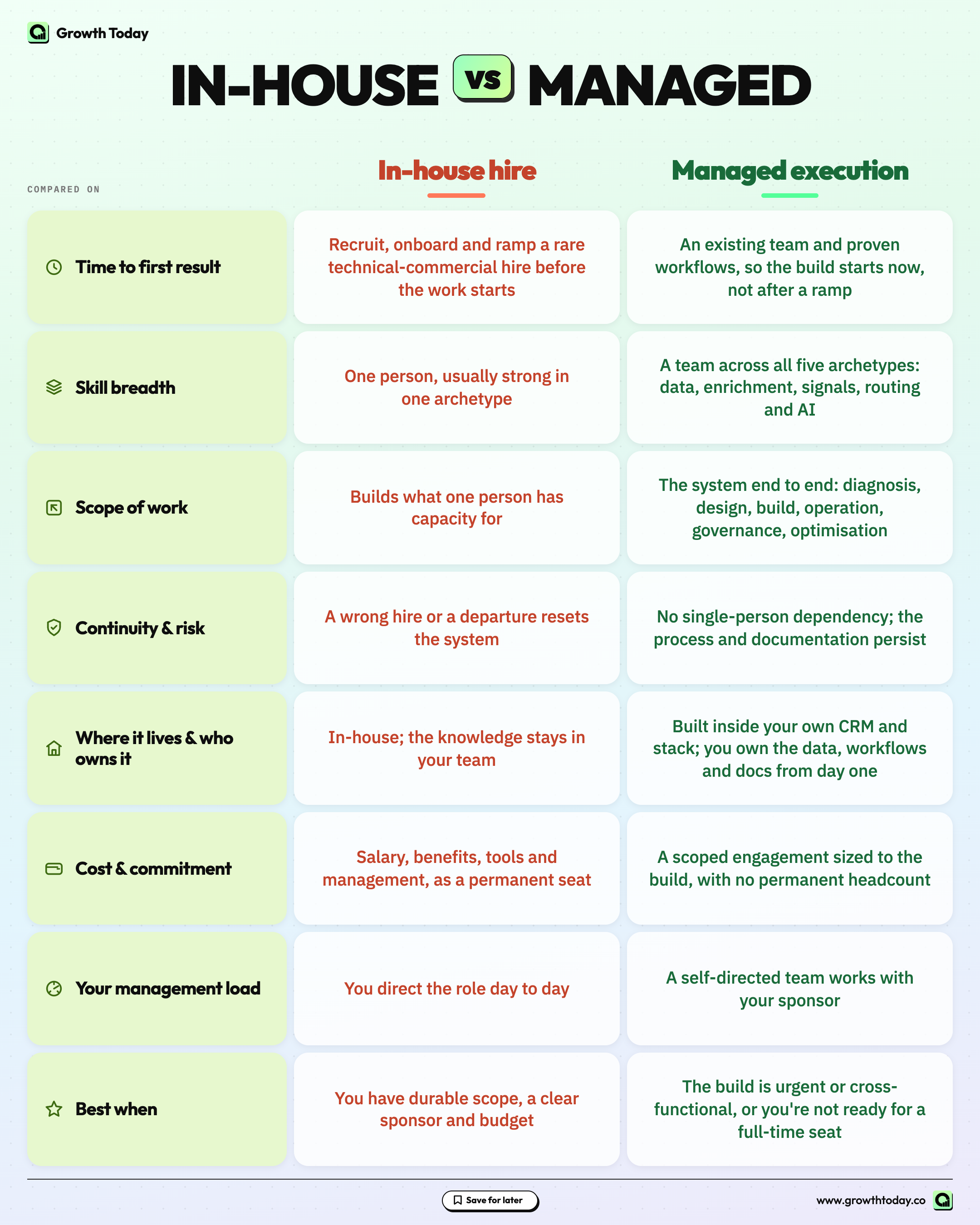
Some companies land in between: they need the capability but are not ready to hire, support, and manage a full-time seat right away. That is the situation Managed GTM Engineering is built for. Growth Today works inside your existing stack and covers diagnosis, design, build, implementation, operation, governance, and optimization, while you retain ownership of your accounts, licenses, data, and workflows.
Managed GTM Engineering is not staff augmentation, and it is not always the better, cheaper, or faster option compared with hiring. It is one path for companies that need strategy plus hands-on execution before they are ready to build and manage a permanent seat.
GTM Engineer job description FAQ
What is the difference between a GTM Engineer, an SDR, and an AE? The GTM Engineer designs and operates the systems that decide who gets contacted and how, the SDR turns that context into qualified conversations, and the AE owns discovery through close. All three share a revenue goal but are measured differently.
Does a GTM Engineer need to code? It depends on the archetype and the company; treat any single posting as one example of how the title gets used, not the standard.
Where should a GTM Engineer sit in the organization? There is no universal answer. Some sit inside RevOps with a defined build mandate, some sit in sales or growth, and some report directly to a revenue leader.
Is a GTM Engineer the same as RevOps? No, but the two overlap, and a GTM Engineer can sit inside RevOps while owning a distinct build and activation mandate.
What should a GTM Engineer own in the first 90 days? A working production result, documentation, and adoption tracking. A bounded pipeline target is reasonable when the role owns a specific automated motion; broader revenue guarantees are not.
When should a company consider Managed GTM Engineering instead of hiring? When the build is urgent, the scope is not yet a stable full-time seat, or the company needs strategy plus hands-on execution before committing to a permanent hire.
Ready to define the GTM system before you write the role?
If your team has the systems problem but not yet the internal build capacity, a Managed GTM Engineering strategy call can help. The call looks at your current GTM motion, where the operating gaps are, and what would be worth building first.
Ready to accelerate your pipeline?
Reach out to discuss how we can help your GTM team scale with automation and expertise.